
The Leather Library
Know what you're sitting on.
Most retailers use the word “leather” as if it means one thing. It doesn't. What follows is the same specification our clients ask for by name — written in plain English, without the marketing.
The four grades
Every hide on the planet falls into one of four categories. The one a factory chooses tells you more about a sofa than its silhouette.
Full-grain
The top 3% of a hide.
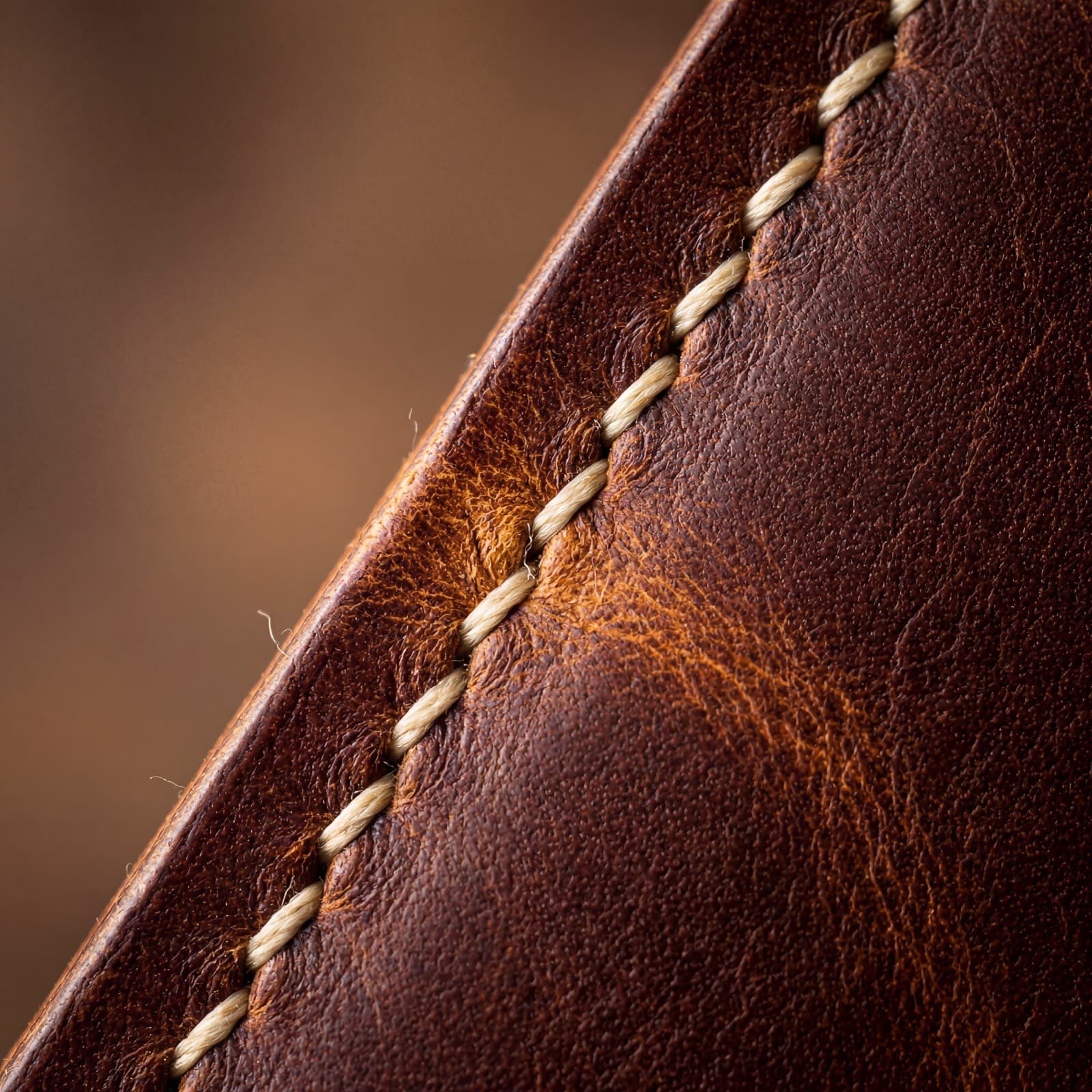
Uncorrected, unsanded, with the grain pattern left intact. Every scar, insect mark, and vein stays visible — these aren't defects, they are the proof it wasn't processed away. Full-grain develops the richest patina and outlasts the frame it's wrapped around.
Reserved for our heritage and prestige pieces.
Top-grain, semi-aniline
The everyday-luxury grade.
Lightly sanded to remove only the surface imperfections, then dyed with aniline and sealed with a thin protective topcoat. The hand is soft, the color is consistent, and spills wipe with a dry cloth. This is what most Italian furniture houses call "premium" — for us, it's the baseline.
Used across our ready-to-ship and made-to-order collections.
Corrected-grain, pigmented
The built-for-life grade.
Sanded and embossed with a uniform grain pattern, then finished with a pigmented topcoat. More forgiving under daily use — pets, children, sunscreen. Lower hand than semi-aniline, higher durability. We offer it as an option on high-traffic modular systems.
Optional upgrade on modular and family-room pieces.
Bonded / split leather
What we will not use.
Reconstituted leather fibers mixed with polyurethane and pressed into a sheet. It feels like leather for the first two years and peels like a bandage after that. Most "leather" sofas under $2,000 are bonded. You'll never see it on a Bella Vero piece — not even on the back panel of a sofa pushed against a wall.
Not offered.
The catalog
Every color in the library.
What follows is the live catalog of leathers and fabrics available across the collection. Hex previews are screen approximations — order swatches to feel the hand and see the color in your own light.
Leather · Leather 3000
Leather · Spessorato
Top-grain Italian leather with a soft hand. The everyday-luxury baseline across the collection.
Article — Spessorato
Nero
Code 700
Natural White
Code 701
Crema
Code 703
Mamotta
Code 707
Mastice
Code 709
Rope
Code 715
Rose
Code 717
Ghiaccio
Code 720
Porcellana
Code 721
Talpa
Code 722
Pietra
Code 723
Elefante
Code 724
Grigio
Code 727
Terra
Code 728
Maranello
Code 737
Cenere
Code 738
Light Grey
Code 739
Cuio
Code 745
Bianco Ottico
Code 751
Panna
Code 752
Blue Marine
Code 780
Sole
Code 781
Blu Elettrico
Code 789
Antracite
Code 790
Leather · Leather 3200
Leather · El Paso, Maya, Queen
Top-grain leather with character — slightly bolder grain and more pronounced color play.
Article — El Paso
Brandy
Brown
Cognac
Darkhan Blu
Color Deserto Brown
Color Cognac Lava
Article — Maya
Brandy
Brown
Cognac
Darkhan Blu
Color Deserto Brown
Color Cognac Lava
Article — Queen
Brandy
Brown
Cognac
Darkhan Blu
Color Deserto Brown
Color Cognac Lava
Leather · Leather 3500
Leather · Patrol, Prince
Premium semi-aniline. Deeper tones, fuller hand, more durable surface treatment.
Article — Patrol
Antracite
Bianco
Fumo
Ghiaccio
Grey
Mocca
Totora
Article — Prince
Antracite
Bianco
Fumo
Ghiaccio
Grey
Mocca
Totora
Hex previews are approximations. Order the swatch kit to feel the hand and see the color under your own lighting.
The hides we use
Bella Vero sources every meter of leather from a short list of Italian tanneries. Here is how that sourcing decision plays out on your floor.
Italian tanneries
All hides pass through tanneries in Tuscany and Veneto — the same districts that supply Italy's leather goods houses. Each tannery holds chain-of-custody documentation for the raw hides.
Vegetable tanning available
On request, we can specify chrome-free vegetable tanning using oak, chestnut, and mimosa bark. Slower, more expensive, and deeper in color. Ask us at the swatch stage.
Matte over mirror
Our finishes are matte and semi-matte — the quiet sheen of a worn saddle, not the plastic gloss of a showroom floor model. High-gloss leather is a 2005 aesthetic and ages badly under Colorado sun.
Hide size & selection
Each sofa seat cushion comes from a single hide panel where possible. We don't splice small cuts across a cushion face. This is more expensive and why our cost-per-square-meter is roughly 2.4× the industry average.
Fabrics
Three fabric tiers (B, C, D) are available alongside leather on most pieces — 100% linen, performance velvet, and bouclé from European mills. Treated with a hidden stain-resistance finish that does not change the hand. Order swatches the same way you would for leather.
Inside the sofa
The leather is the surface. What lives underneath is what makes a sofa last thirty years instead of seven.
Frame
Kiln-dried solid hardwood
Beech and poplar, kiln-dried to 8–10% moisture content before milling. Joinery is mortise-and-tenon at the high-stress corners, glued and dowelled. No staples in the load path. The frame outlives the upholstery — that is the whole design intent.
Suspension
Eight-way hand-tied springs · seat
Tempered steel coils, hand-tied with twine in eight directions across each seat platform. Slower than sinuous-wire, holds its shape decade after decade. Sinuous wire is reserved for back and arm sections where compression load is lower.
Foam core
HR cold-cure, density-graded
High-resilience cold-cure foam — 35–45 kg/m³ density on seat cushions, lower-density wrap on backs. We do not use HR-block foam (the cheaper warm-cure variant) because it loses 20–30% of its support in the first five years. Cold-cure holds.
Fill
Goose-down feather wrap
Cushions on our heritage and prestige pieces are wrapped in a baffled goose-down envelope around the foam core — the soft tactility of down with the structural memory of foam. Fluff weekly. The wrinkles are a feature.
Patina — a living record
Full-grain leather doesn't age, it develops. If anyone tells you an heirloom piece should look identical in year ten as it did on delivery day, they're describing plastic.
What to expect from a Bella Vero piece over time:
- —Small color shifts in the first 6-12 months — the piece is settling into your light.
- —A slight softening of the grain where you sit most often — leather is mapping your use.
- —Faint warm spots where afternoon sun hits — full-grain darkens under UV before it fades.
- —Minor wrinkles in the seat cushion — the fiber relaxing, not failing. This is not a warranty issue.
Care, the short version
You don't need a $60 conditioning kit. You need these four habits.
Dust with a soft microfiber cloth. Vacuum the creases with an upholstery attachment on the lowest setting.
Wipe with a barely-damp cloth (distilled water if your tap is hard). Dry immediately — leather and standing water don't mix.
Apply a pH-neutral leather conditioner. Test in a hidden spot first. Two light coats beat one heavy one.
Keep the piece 3+ feet from direct sunlight and heat vents. Blot spills immediately with a dry cloth — never rub, never use household cleaners or saddle soap.
Materials, in one breath
The four questions our clients ask most often before they commission a piece.
Why is full-grain leather so much more expensive?
It comes from the top 3% of hides — the ones whose surface is uncorrected, unsanded, and intact. The yield from a single hide is roughly half what a corrected-grain factory gets, and the selection is more conservative. You pay for the rejection rate.
What is the difference between aniline, semi-aniline, and pigmented leather?
Aniline: dyed through, no surface coat — softest hand, most prone to staining. Semi-aniline: dyed through, then a thin protective topcoat — soft hand, spills wipe with a dry cloth. Pigmented: opaque surface coat — most durable, lowest hand. We use semi-aniline as the baseline and offer aniline on prestige pieces.
Do you use chrome-tanned or vegetable-tanned leather?
Chrome-tanned by default — it produces a softer, more colour-stable hide. Vegetable-tanned leather is available on request at the swatch stage and adds 4–6 weeks to the lead time. Vegetable tanning uses oak, chestnut, and mimosa bark instead of chromium salts; the colour deepens with age in a way chrome cannot match.
What is the foam density on the seat cushions?
Standard pieces ship with 35 kg/m³ HR cold-cure foam in the seat. Heritage pieces step up to 45 kg/m³ with a goose-down wrap. We can quote 50 kg/m³ on commission for clients with specific firmness preferences.
Next step
Order the hides yourself.
Reading about leather is the first half. Holding it under your own lamp is the second. Every Bella Vero swatch is a real piece of the hide your sofa would ship in — not a printed card.
Request a free swatch kit